
Explainers
Learn: multi-model AI, routing and orchestration
Plain explanations of the techniques behind multi-model AI — routing, consensus, verification, RAG, memory, and running open-weight models on your own hardware.
Last reviewed:
See it in the app
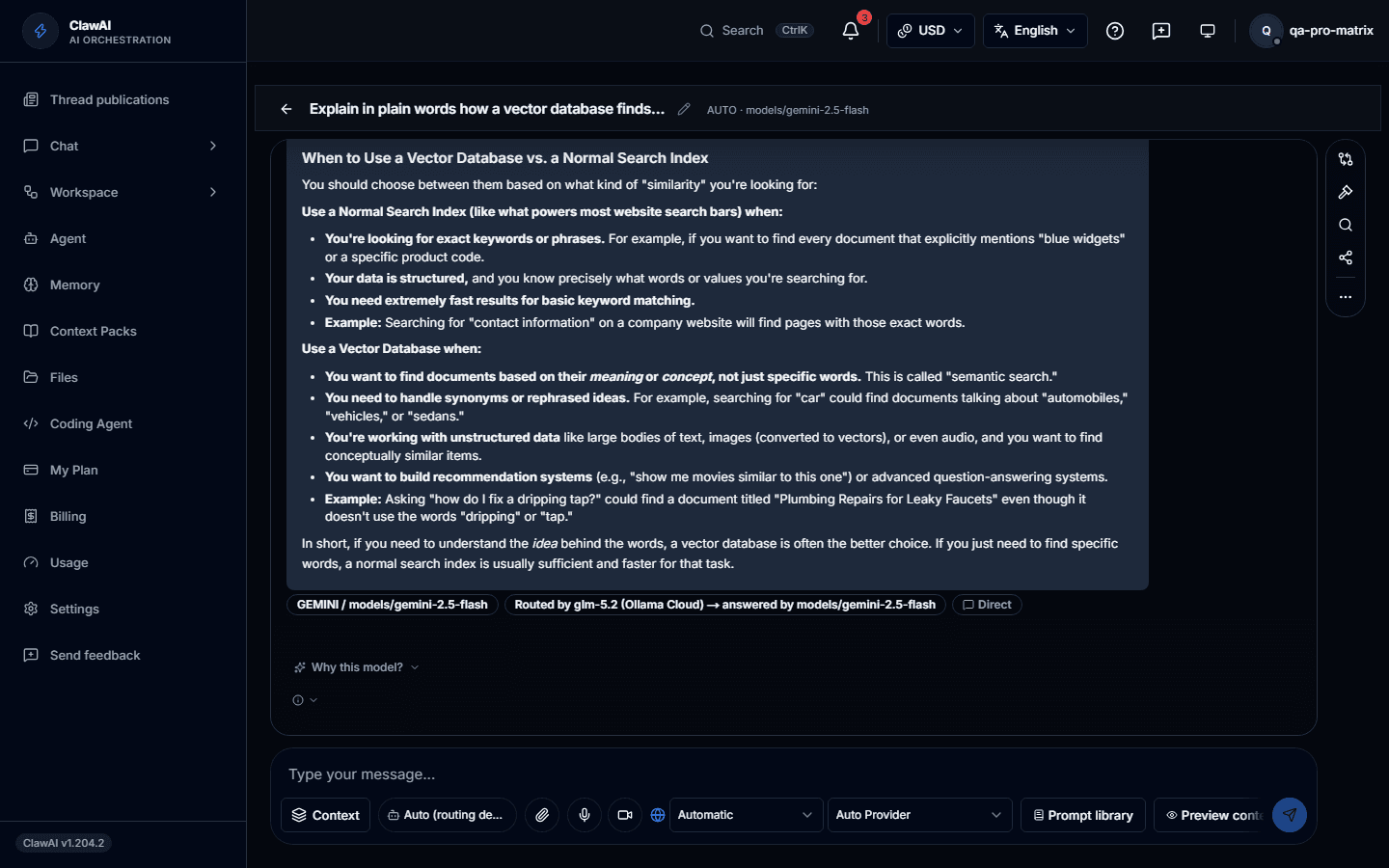
Every answer shows which model wrote it and why.
Pick a concept
- How language models generate answersHow a prompt becomes tokens, probabilities and one generated answer.
- What are AI tokens?The unit a model actually reads and writes, and why an exact count needs its own tokenizer.
- What do temperature and top-p control?What temperature and top-p actually change about an answer — and what they can’t change.
- What are embeddings?How text becomes a vector of numbers, and why that is what makes search by meaning possible.
- Prompting vs. RAG vs. fine-tuning: how do they differ?Three different fixes for three different problems, and why many products never need the third.
- How does AI tool calling actually work?The model never runs anything — it proposes a call, and your application decides what happens next.
- What are structured AI outputs?Asking a model for JSON is a request; only some mechanisms actually guarantee it matches your schema.
- Why does AI hallucinate?Why a model states a wrong answer with the same confidence as a right one — and what actually reduces it.
- What is multi-model AI?Using several models in one workflow instead of committing to one.
- What is LLM orchestration?The layer that decides which model runs, in what order, and what happens to the output.
- What is AI model routing?Sending each request to a model chosen by task, cost, privacy or latency.
- What is model fallback?What should happen when the first model is down, rate-limited or refuses.
- What is AI consensus?Asking several models the same question and using their agreement as a signal.
- What is best-of-N?Generating several candidate answers and keeping the best one.
- What is an AI judge?Using a model to score other models’ answers, and where that breaks down.
- What is AI answer verification?Checking an answer against something other than the model that produced it.
- What is a context window?The working memory of a single request, and why it is not the same as memory.
- What is retrieval-augmented generation?Retrieving your own documents and putting them in front of the model.
- What is AI memory?What persists between conversations, and what it costs you.
- What are context packs?Reusable bundles of context you attach to a conversation on purpose.
- What is local AI?Running a model on hardware you control, and what that actually changes.
- What are open-weight models?Models whose weights you can download — and what "open" does and does not mean.
- What is self-hosted AI?Running the whole application yourself, not just the model.
- Ollama vs llama.cppTwo ways to run open-weight models locally, and which job each suits.
- Cloud AI vs local AIThe real trade: capability and convenience against control and cost shape.
- AI agent vs AI chatbotThe difference between answering you and doing something for you.
- How to evaluate AI models for your own useWhat to actually test before trusting a model with your work — not a leaderboard number.
- How to read AI benchmarks without being misledWhat a benchmark number actually measures, and the ways it can mislead you before you even start testing.
- What is prompt injection?Text that isn’t from you can still give the model instructions — what that means and why it can’t be fully solved by a smarter model.
- AI data privacy and retention, explainedWhat actually happens to what you type into an AI product — who sees it, whether it trains a model, and how long it sticks around.