
Routing
What is AI model routing?
Model routing sends each request to a model chosen by task, cost, privacy or latency instead of using one model for everything. How routers decide, and how they fail.
All explainers · Last reviewed:
See it in the app
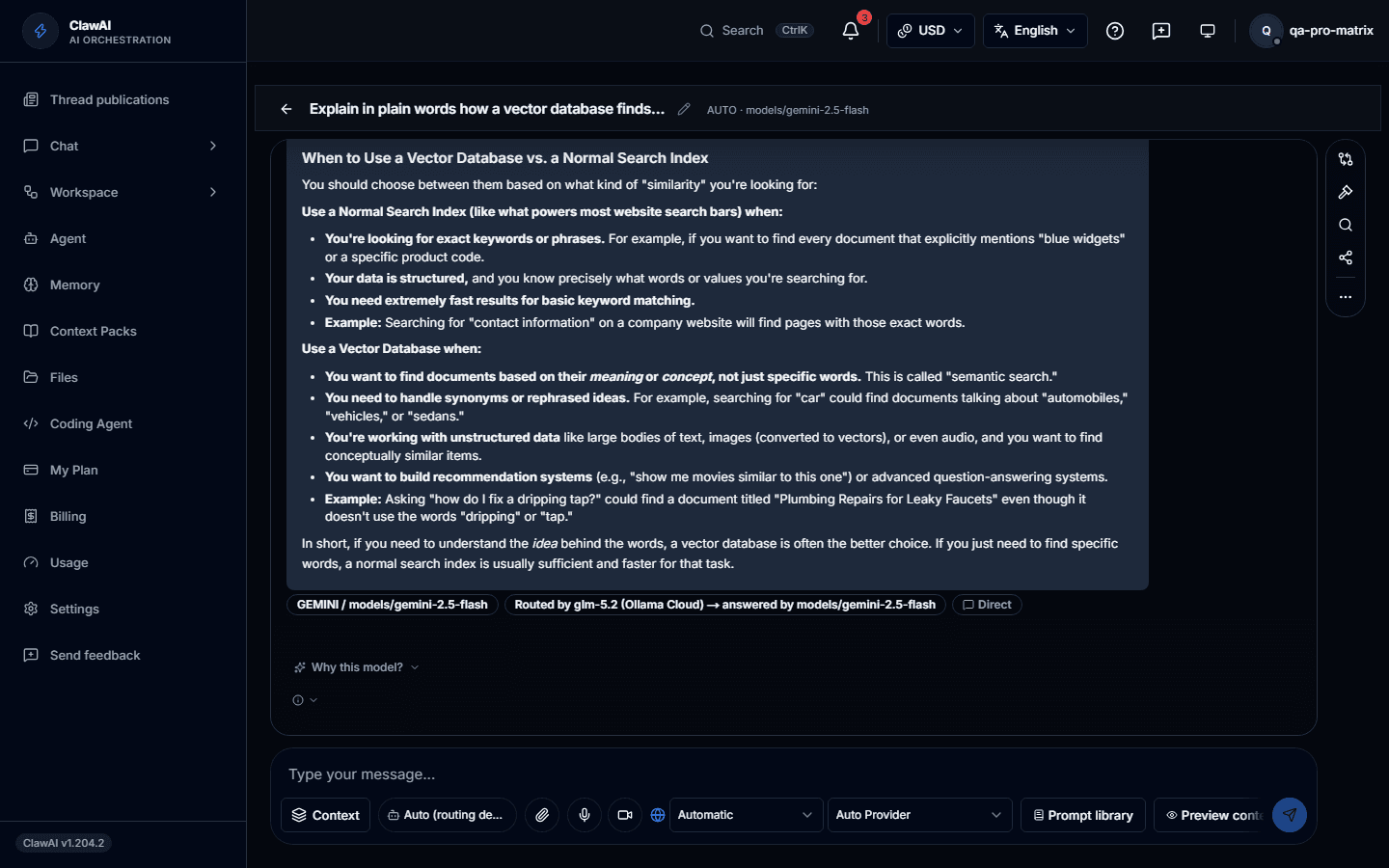
Every answer shows which model wrote it and why.
What a router decides on
Most routers combine a few signals: what kind of task it looks like, how long the input is, how sensitive the data is, how fast the answer needs to be, and how much the request is allowed to cost.
Those signals conflict. The fastest model is rarely the strongest; the most private option is rarely the most capable. A router is really a policy about which of those to sacrifice, so the useful ones let you say which you care about rather than guessing.
Automatic and explicit routing
Automatic routing reads the request and decides. It is convenient and occasionally wrong, and being wrong is hard to notice if the system does not tell you which model answered.
Explicit routing means you state the priority — keep this local, keep this cheap, use the strongest reasoning available — and the router honours it. In practice most people want both: a sensible default, and the ability to override it for the request in front of them.
How routing goes wrong
The two common failures are silent downgrades and invisible decisions. A silent downgrade is a router quietly sending your careful request to a cheap model. An invisible decision is any routing you cannot audit after the fact.
Both have the same fix: the system should record which model actually answered, and show it. A router you cannot inspect is indistinguishable from a router that is broken.
How ClawAI does it
ClawAI has 7 routing modes. Auto reads the request and chooses. Manual pins one model. Local-only keeps the whole chain on models running on your own hardware. Privacy-first prefers local and refuses to leave it silently. The rest bias the choice toward lower latency, stronger reasoning, or lower cost.
Every answer records the model that produced it, so an automatic decision is checkable rather than trusted.
Questions people ask
- Does routing reduce answer quality?
- It can, if the policy is wrong for the request. That is why the mode is yours to choose and why the model that answered is shown. Routing that you can see and override is a cost control; routing you cannot is a downgrade.
- Can a router keep data off cloud providers entirely?
- Only if it is allowed to refuse rather than fall back. A local-only mode whose fallback chain reaches a cloud provider is not a privacy control. ClawAI’s local-only mode keeps its fallback chain on local providers.
- Is routing worth it for one person?
- Usually yes, for cost rather than reliability. Most individual workloads are mostly routine questions with a few hard ones; sending the routine ones to a cheaper model is the single biggest lever on a personal AI bill.
Try it rather than read about it
ClawAI ships 7 routing modes and shows the chosen model on every message, so you can check the router rather than trust it.