
ClawAI vs Kimi
ClawAI vs Kimi
Open weights you run yourself versus nine families in one workspace: how ClawAI and Kimi differ on model choice, routing, long context and self-hosting.
Compared on public information, last checked:
See it in the app
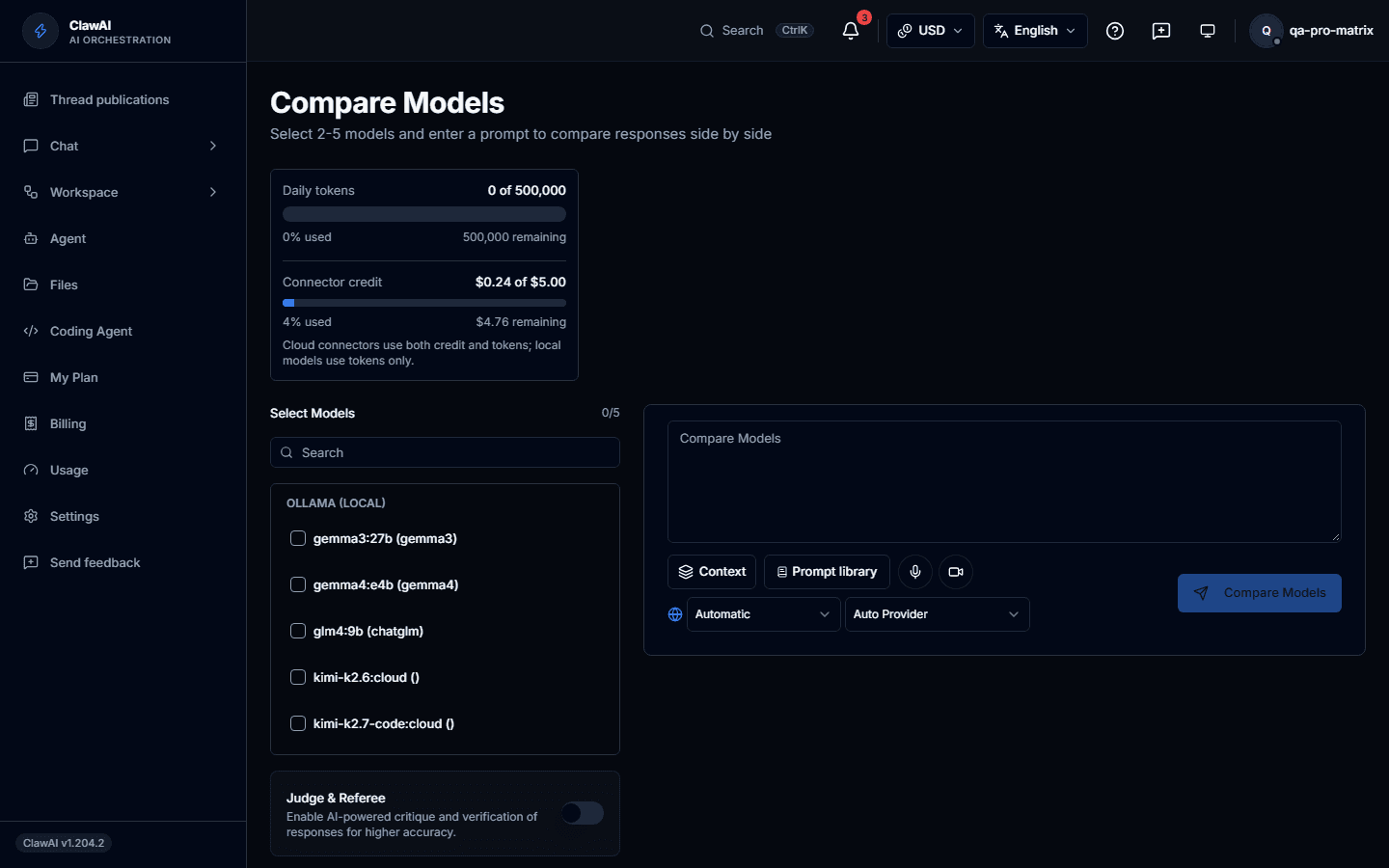
Ask one question and see three models answer side by side.
Kimi built its reputation on very long context and, more recently, on releasing open weights that anyone can download and run. ClawAI is a different shape: one workspace that reaches Kimi-class open-weight models alongside eight other families, and sends each message to whichever suits it.
At a glance
| Capability | ClawAI | Kimi |
|---|---|---|
| Model choice | 21 cloud providers, plus open-weight models on your own hardware | Moonshot models only |
| Routing | 7 routing modes, including automatic per-message routing | Selection within Moonshot’s own range |
| Side-by-side answers | One prompt to several models at once, answers side by side | One answer at a time |
| Local and open-weight models | Open-weight models on your own GPU, via Ollama or llama.cpp | Open weights published, hosting is your own problem |
| Self-hosting | The whole stack runs on your servers, source on GitHub | Weights yes, product no |
| Memory and files | Memory that persists between conversations, plus file context | Long-context file reading |
| Workspace connectors | 14 workspace connectors | Limited outside its own apps |
| Usage receipts | Every answer records its model, its cost and the allowance it drew | API-level usage, not per-answer cost |
Where Kimi is strong
Long-context reading at a price that undercuts most Western frontier models, strong agentic and tool-use behaviour, and open weights for the flagship line — so the same model can be evaluated in the hosted product and then run on your own hardware.
Where ClawAI works differently
ClawAI does not ask you to pick a lab. An open-weight model can answer the questions where cost or residency matters, a frontier model can take the ones that need it, and the routing decision is recorded per answer instead of being a habit you have to remember.
Which one to choose
Choose Kimi if
your work is dominated by very long documents, you are comfortable with a single vendor, and the price per token is the number that decides it.
Choose ClawAI if
you want open-weight economics on some messages and frontier quality on others, without running two subscriptions and deciding by hand each time.
Questions people ask
- Can ClawAI use Kimi models?
- ClawAI reaches open-weight models of this class through its own roster, and can run them locally on your GPUs. There is no separate account to create and no API key to paste.
- Is running open weights myself cheaper than a subscription?
- At sustained volume it can be, once you own the GPUs and the operational time. ClawAI is aimed at the case in between: open-weight economics for the messages that suit them, frontier models for the ones that do not, on one bill.
- Does my data leave the network if I use a local model?
- No. Pin a conversation to a local open-weight model and nothing is sent to an external provider. Self-hosting the whole stack removes external calls entirely.
ClawAI is an independent product. It is not affiliated with, endorsed by, or reselling on behalf of any assistant named on this page. Every claim is drawn from each vendor’s public documentation on the date above, and these products change quickly — check the vendor’s own pages before you decide.
Open weights you run yourself versus nine families in one workspace: how ClawAI and Kimi differ on model choice, routing, long context and self-hosting.